INDO RECIPES FOR U: Indonesia

Halaman

    Social Items

Daun Pandan   =   Pandan Leaf /Screwpine Leaf/Pandanus amaryllifolius


Pandanus amaryllifolius is a tropical plant in the Pandanus (screwpine) genus, which is commonly known as pandan leaves (/ˈpændənˌlivz/) and is used widely in Southeast Asian cooking as a flavoring. The characteristic aroma of pandan is caused by the aroma compound 2-acetyl-1-pyrroline, which may give white bread, jasmine rice and basmati rice (as well as bread flowers Vallaris glabra) their typical smell.[2] The plant is rare in the wild but is widely cultivated. It is an upright, green plant with fan-shaped sprays of long, narrow, bladelike leaves and woody aerial roots. The plant is sterile, with flowers only growing very rarely, and is propagated by cuttings.


In India and Bangladesh, it is called Rampe and ketaki respectively, along with the other variety of pandan there (Pandanus fascicularis), and is used to enhance the flavor of pulao, biryani and sweet coconut rice pudding, payesh if basmati rice is not used. It acts as a cheap substitute for basmati fragrance as one can use normal, non-fragrant rice and with the help of pandan, the dish tastes and smells like basmati is used. It is called Ambemohor pat in Marathi; Ramba in Tamil, Biriyanikaitha in Malayalam, pandan wangi in Indonesian, hsun hmway (ဆွမ်းမွှေး) in Burmese, pandán in Filipino, bai tooey in Thai, rampe in Sinhala, sleuk toi in Khmer, Daun Pandan in Nonya cooking,[3] lá dứa in Vietnamese, 香兰 ("Xiāng lán") in Chinese and बासमतिया पौधा [bɑːsmət̪ɪjɑː pɑʊd̪ʱɑː] "fragrant plant" in Magahi and Bhojpuri due to its fragrance.


The leaves are used either fresh or dried and are commercially available in frozen form in Asian grocery stores in nations where the plant does not grow. They have a nutty, botanical fragrance that is used as a flavor enhancer in India, Indonesian, Singaporean, Filipino, Malaysian, Thai, Bangladeshi, Vietnamese, Chinese, Sri Lankan, Khmer, and Burmese cuisines, especially rice dishes and cakes.


Biriyanikaitha in Kerala, India
The leaves are sometimes steeped in coconut milk, which is then added to the dish. They may be tied in a bunch and cooked with the food. They may be woven into a basket which is used as a pot for cooking rice. Pandan chicken, (Thai: ไก่อบใบเตย, kai op bai Toei), is a dish of chicken parts wrapped in pandan leaves and baked. The leaves are also used as a flavoring for desserts such as pandan cake and sweet beverages. Filipino cuisine uses pandan as a flavoring in buko pandan fruit salad, as well as rice-based pastries and numerous sweet drinks and desserts.[4]

Bottled pandan extract is available in shops and often contain green food coloring. The leaves also notably have a repellent effect on cockroaches.[5]


Source: WIkipedea

Daun Pandan = Pandan Leaf /Screwpine Leaf/Pandanus amaryllifolius

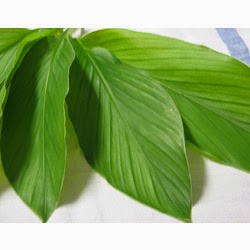
Daun Kunyit   =   Turmeric Leaf
http://indorecipes4u.blogspot.com/
Turmeric (Curcuma longa) /'t?rm?r?k/ or /'tju?m?r?k/ or /'tu?m?r?k/[2] is a rhizomatous herbaceous perennial plant of the ginger family, Zingiberaceae.[3] It is native in southwest India, and needs temperatures between 20 and 30 �C (68 and 86 �F) and a considerable amount of annual rainfall to thrive.[4] Plants are gathered annually for their rhizomes, and propagated from some of those rhizomes in the following season.

When not used fresh, the rhizomes are boiled for about 30�45 minutes and then dried in hot ovens,[5] after which they are ground into a deep-orange-yellow powder commonly used as a spice in Indian cuisine and curries, for dyeing, and to impart color to mustard condiments. One active ingredient is curcumin, which has a distinctly earthy, slightly bitter, slightly hot peppery flavor and a mustardy smell.


Botanical view of Curcuma longa

Turmeric field in an Indian village
India, a significant producer of turmeric,[6] has regional names based on language and country.


Turmeric is a perennial herbaceous plant, which reaches up to 1 m tall. Highly branched, yellow to orange, cylindrical, aromatic rhizomes are found. The leaves are alternate and arranged in two rows . They are divided into leaf sheath, petiole, and leaf blade.[10] From the leaf sheaths, a false stem is formed. The petiole is 50 to 115 cm long. The simple leaf blades are usually 76 to 115 cm long and rarely up to 230 cm. They have a width of 38 to 45 cm and are oblong to elliptic narrowing at the tip .


Turmeric, whose biological name Curcuma longa, has been used in India as part of Ayurvedic medicine, and in Chinese medicine for thousands of years, to treat a variety of health conditions. An active ingredient in the turmeric leaf is curcumin, which is a powerful antioxidant.


As part of Ayurvedic medicine, turmeric leaves can be crushed into a paste and applied to the skin. This use dates back to ancient times and is still in use today in India. It is believed turmeric may help keep the skin soft and smooth, make the skin glow, produce a fairer complexion and remove blemishes such as spots. It is also used to alleviate skin conditions such as eczema and as an antiseptic to treat cuts and burns.


Tumeric leaves, also known as haldi leaves, are used extensively as aromatic herbs in Indian, Thai and Malaysian cooking. Fresh turmeric leaves are used whole in select dishes and dried turmeric leaves soaked in water with the extract used in cooking. Turmeric leaves are also used as food coloring and as a basic ingredient in curry powders. Turmeric leaves are purported to improve digestion and reduce gas and bloating.


Turmeric grows wild in the forests of South and Southeast Asia. It is one of the key ingredients in many Asian dishes. Indian traditional medicine, called Siddha, has recommended turmeric for medicine. Its use as a coloring agent is not of primary value in South Asian cuisine.

Turmeric is mostly used in savory dishes, but is used in some sweet dishes, such as the cake sfouf. In India, turmeric plant leaf is used to prepare special sweet dishes, patoleo, by layering rice flour and coconut-jaggery mixture on the leaf, and then closing and steaming it in a special copper steamer (goa).

In recipes outside South Asia, turmeric is sometimes used as an agent to impart a rich, custard-like yellow color. It is used in canned beverages, baked products, dairy products, ice cream, yogurt, yellow cakes, orange juice, biscuits, popcorn color, cereals, sauces, gelatins, etc. It is a significant ingredient in most commercial curry powders.

Most turmeric is used in the form of rhizome powder; in some regions (especially in Maharashtra, Goa, Konkan and Kanara), turmeric leaves are used to wrap and cook food. Turmeric leaves are mainly used in this way in areas where turmeric is grown locally, since the leaves used are freshly picked. Turmeric leaves impart a distinctive flavor.

Although typically used in its dried, powdered form, turmeric is also used fresh, like ginger. It has numerous uses in Far Eastern recipes, such as pickle that contains large chunks of soft turmeric, made from fresh turmeric.

Turmeric is widely used as a spice in South Asian and Middle Eastern cooking. Many Persian dishes use turmeric as a starter ingredient. Almost all Iranian khoresh dishes are started using onions caramelized in oil and turmeric, followed by other ingredients.

In India and Nepal, turmeric is widely grown and extensively used in many vegetable and meat dishes for its color, and is also used for its supposed value in traditional medicine.

In South Africa, turmeric is used to give boiled white rice a golden colour.

In Vietnamese cuisine, turmeric powder is used to color and enhance the flavors of certain dishes, such as bánh xèo, bánh khọt, and mi quang. The powder is also used in many other Vietnamese stir-fried and soup dishes.

In Indonesia, turmeric leaves are used for Minangese or Padangese curry base of Sumatra, such as rendang, sate padang, and many other varieties.

In Thailand, fresh turmeric rhizomes are widely used in many dishes, in particular in the southern Thai cuisine, such as the yellow curry (แกงเหลือง) and turmeric soup (ต้มขมิ้น).

In medieval Europe, turmeric became known as Indian saffron because it was widely used as an alternative to the far more expensive saffron spice.[14]

Source
WIKIPEDIA

Daun Kunyit = Turmeric Leaf

Fried chicken with green chili

fried chicken with green chili
Thanks for visit my blog.
this time indonesiaoriginal recipes will share how to make fried chicken with green chili.
this food usualy servering in padang restourant.
padang food famous with redang and spicy food.
oke lest go we make fried chicken with green chili 

fried chicken with green chili ingredients:
1/2 kg chicken cut into 5 piece ( fry lift and dry )
50 gram green chili ( chopped )
50 gram green tomato ( sliced )
1 tablespon sugar

fried chicken with green chili blended seasoing :
2 garlic
4 red onion
1/2 teaspoon salt

how to make fried chicken with green chili :
- stir fry blended seasoing until fragnant
- add green chili, green tomato, fried chicken, sugar and 200ml water
- coocked until spices to infuse
- lift and serve

fried chicken with green chili

tofu vegetarian steak ( steak tahu vegetarian )

tofu vegetarian steak ( steak tahu vegetarian )


oke tis time indonesian original recipes will share how to make tofu vegetarian steak
tofu is a product from soybean which is the source Texturized vegetable protein (TVP).
usualy often use alternate to meat for vegetarian.

ingredients tofu vegetarian steak ( steak tahu vegetarian ):

- 150 gram tofu
- 1 egg
- 1 ons bread flour
- 2 potato, leghty sliced, fry
- 1 carots, leghty sliced, boiled
- 5 bean, boiled
- 3 redonion ( blended )
- 2 garlic ( blended )

ground spices tofu vegetarian steak :

- 1/4 teaspoon nutmeg
- 1/2 teaspoon pepper
- 1/4 teaspoon salt
- 1/4 teaspoons MSG ( Optional )
- 2 tablespoon tomato sauce
- 3 tablespoon chillie sauce
- 2 tablespoon mayonaise


how to make tofu vegetarian steak ( steak tahu vegetarian ) :

- mix together tofu, blended red onion and garlic
- add nutmeg, pepper, salt and mix together again
- mold like picture
- mix egg and sugar, to dip dough, lift and sprinkle bread flour
- fry until change colour ( yelow brown ) and lift and dry

how to make sauce tofu vegetarian steak ( steak tahu vegetarian ) :

- preheat the pan, add tomato sauce, chillie sauce, mayonnaise, msg, sugar and water
- coocked until boiling and lift

tofu vegetarian steak ( steak tahu vegetarian )

serabi solo cake


oke this day indorecipes4u will share how to make serabi solo cake.
serabi solo cake is a traditional cake from solo, in solo many restourant serve this cake.
in solo serabi notosuma is a famous restourant servering this cake.

serabi solo cake ingredien:
- 1 tablespoon wheat flour
- 1 tablespoon sugar
- 5 grm instan yeast
- 250 gram rice flour
- 125 gram sugar
- 1 egg
- 500 ml coconut milk
- grated cheese for tooping

how to make serabi solo cake :
- before we make serabi solo cake we must make main dough
  main dough make with wheat flour, sugar, yeast and water mix together and let the dough until 5 minutes.
- mix rice flour, sugar, egg, main dough and 200ml coconut milk. mix together with hand until dough mixed and add 300 ml coconut milk
- mix again and then let the dought 2 hours
- heat mold with small fire.pour 150ml dough and press.
- coocked until 4 minutes and lift.
- serve with grated chees toping

serabi solo cake

how to make shirmp indonesian cracker ( kerupuk udang indonesia )


crackers always served complementary foods. in indonesia crackers have various types.
but this time i will share how to make shirmp indonesian crackers in indonesian called ( kerupuk udang ).
shirmp crackers a flour-based foods and shrimp finely ground.


ingredients how to make shirmp indonesian crackers:

- 2 kg wheat flour
- 2 kg fresh shirmp
- 10 garlic
- salt
- sugar
- msg
- water
- oil to frying

how to make shirmp indonesian crackers :

- peel of shirmp skin and remove head, wash thoroughly and dry
- blended shirmp and pour into pan
- mix shirmp with wheat flour, garlic, salt, msg and mix together until blended
- add water gradually
- knead with hands until dough is not sticky
- wrap up the dough with banana leaves and roll lengthwise
- steam until 3 hours. left and dry

- after cold, thinly sliced the dough dried in the sun to dry

- heat olive oil and the fry the dough
- lift dry and serve

how to make shirmp indonesian cracker ( kerupuk udang indonesia )

Javanese Duck Rica Rica ( Rica Rica Bebek )

http://indorecipes4u.blogspot.com/
javanese duck rica rica is a famous food from java, duck coocking with rica rica seasoing and pepper very delicious if servering in cold weather.
this recipe come from javanese, in here this recipe many servering in restourant.
oke lets go we make javanese duck rica rica


ingredients javanese duck rica rica:
- 500 grm duck ( cut into piece )
- 2 tablespoon vegetable oil
- 1 teaspon sugar
- 1 teaspon palm sugar
- 3 lime leave
- 500 ml water
- 1 lemon gras ( bash )

seasoing :
5 Thai pepper / bird's eye chili peppe
3 chilie
8 red onion
6 garlic
2 teaspoon pepper

complementary seasonings:
1 onion thinly sliced

how to make java duck rica rica :
- mashed seasoing ( thai pepper, chilie, red onion, garlic, pepper )
- heat vegetable oil
- saute seasoing, sliced onion and lemon gras until fragnant
- add lime leave
- add duck meat and coocked until meat tender ( about 30 minutes )
- serve

Javanese Duck Rica Rica ( Rica Rica Bebek )

Daun Pisang  =  Banana Leaf


Banana leaves serve many purposes in Asian cooking, from adding flavor to foods cooked inside them, to simply being used as a colorful and exotic background for serving-plates and party platters. Banana leaves are beautiful, fun to use, and easy to cook with!


Banana leaves used in cuisine are generally large, flexible, and waterproof.[3] When cooking food with or serving or wrapping food with banana leaves, they may confer an aroma to the food leaves; steaming with banana leaves imparts a subtle sweet flavour to the dish.[4]

The leaves contain the juices, protect food from burning and add a subtle flavor.[5] In Tamil Nadu (India) leaves are fully dried and used as packing material for food stuffs and also making cups to hold liquid foods. The dried leaves are called 'Vaazhai-ch- charugu' (?????? ?????) in Tamil. Some South Indian, Filipino and Khmer recipes use banana leaves as a wrapper for frying. The leaves are later removed to retain flavor. In Vietnamese cuisine, banana leaves are used to wrap foods such as cha-lua.


In Indonesian cuisine, banana leaf is employed in cooking method called pepes and botok; the banana leaf packages containing food ingredients and spices are cooked on steam, in boiled water or grilled on charcoal. Banana leaves are also used to wrap several kinds of snacks kue (delicacies), such as nagasari or kue pisang and otak-otak, and also to wrap pressed sticky rice delicacies such as lemper and lontong.


In Java, banana leaf is also used as a coned plate called "pincuk", usually to serve rujak tumbuk, pecel or satay. The pincuk is made by creating shallow cone-shaped banana leaf plate secured with lidi semat (small thorn-like nail made from the coconut leaf mid rib). The pincuk fit the left palm while the right hand used to consume the food. It is functioned as a traditional disposable take-away food container. The cleaned banana leaf is often used as a plate mat; cut banana leaf sheets placed upon rattan, bamboo or clay plates are used to serve food upon it. Decorated and folded banana leaves upon woven bamboo plate are used as the tray to serve tumpeng rice cone and jajan pasar or kue delicacies.


SOURCE
WIKIPEDIA

Daun Pisang = Banana Leaf